
Podcast: Play in new window | Download (Duration: 34:26 — 27.6MB) | Embed
Subscribe: Apple Podcasts | Spotify | Email | RSS | More
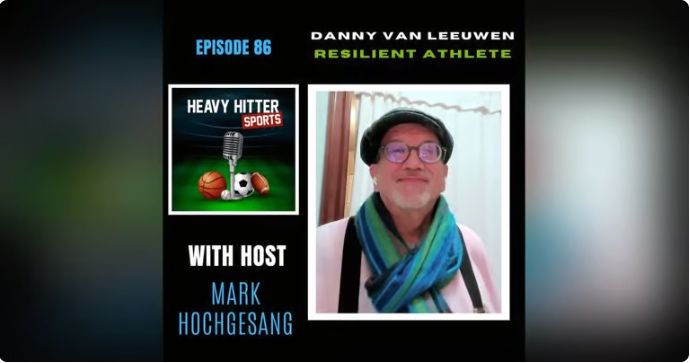
Former Nike exec Mark Hochgesang interviews Danny on Heavy Hitter Sports Podcast about MS & being an adaptive athlete. Just back from Belize! Training works.
Summary
My friend Mark Hochgesang, former Nike exec and host of Heavy Hitter Sports, recently interviewed me. While I usually wear my life on my sleeve on Health Hats, this conversation revealed something different—how I think about myself as an adaptive athlete.
Phil Knight’s mantra: “If you have a body, you’re an athlete.”
I never thought of it that way until Mark helped me see it. Training to travel? That’s athletic training. Loading a 60-pound wheelchair into an SUV? Strength work. Walking 3,500 steps a day with MS? Competition with myself.
Here’s what we covered:
🧠 The Swiss cheese brain scan – My MS diagnosis story (turns out I’d had it for 25 years)
🎷 The baritone saxophone – My neurologist’s #1 prescription for MS. Music creates new neural pathways.
🚶 The 3,500-step goal – Why movement is non-negotiable, even with foot drop and proprioception issues
💪 The “every other day” rule – Setting yourself up for success (stretching, balance, upper body work, squats)
😤 The two-minute bitch – No “happy horseshit” allowed. Life with MS sucks sometimes. Two minutes to vent, then move forward.
🌍 Training to travel – From 70 miles of Camino de Santiago to just returning from Belize (videos coming!)
👨👩👦 The team – Wife (OT), sons, grandkids (my scouts!), medical team, massage therapists, the Cuban van driver who didn’t speak English
🎯 The win – People understanding that disability takes many forms and asking “How can I help you?” instead of aggressively helping
💡 The legacy – Being remembered as “the cool Opa”
The biggest lesson? Build a team. You can’t do this shit alone.
Click here to view the printable newsletter with images. More readable than a transcript.
Contents
Please comment and ask questions:
- at the comment section at the bottom of the show notes
- on LinkedIn
- via email
- YouTube channel
- DM on Instagram, TikTok to @healthhats
- Substack
- Patreon
Production Team
- Kayla Nelson: Web and Social Media Coach, Dissemination, Help Desk
- Leon van Leeuwen: editing and site management
- Oscar van Leeuwen: video editing
- Julia Higgins: Digit marketing therapy
- Steve Heatherington: Help Desk and podcast production counseling
- Joey van Leeuwen, Drummer, Composer, and Arranger, provided the music for the intro, outro, proem, and reflection
- Claude, Perplexity, Auphonic, Descript, Grammarly, DaVinci
Inspired by and Grateful to: my entire team
Photo Credits for Videos
Featured Image by Mark Hochgesang
Referenced in episode
Episode
Proem
Mark Hochgesang, a former Nike exec and my podcasting buddy, recently hosted me on his podcast, Heavy Hitter Sports. You all know I wear my life on my sleeve and take any opportunity to talk about myself. I’m sharing this episode of Mark’s because it reveals a different story of my abilities and self-image, which I now tell through my collaboration with Mark and his deep understanding of sports.
Redefining Athletic Performance
Mark: Welcome to Season 4 of Heavy Hitter Sports, where we talk to inspirational figures in the world of sports. Athletes come in many shapes and sizes, and not all heroes perform on a big stage. Today’s episode is a bit different and one that I’ve long been looking forward to. It’s focused on how we adapt to unplanned life changes and adversity, then train, compete, and battle to win on our own terms. My guest is a good friend and fellow podcaster, Danny van Leeuwen. Danny is a former nurse, healthcare executive, musician, traveler, and a man who has lived with multiple sclerosis for many years. This is not a tale about limitations or illness. It’s a story about focus, fortitude, optimism, preparation, and team-building to live an amazing life. Danny’s story as an adaptive athlete challenges us to rethink what strength, toughness, and success look like. If you care about maintaining optimal health, sharpening your mindset, and winning the long game, this is the episode for you. Danny, welcome, my good friend. I’m looking forward to catching up and talking to you about some of the challenges that have been thrown your direction in life. And I’d like to open by getting your thoughts on this Nike mantra first uttered by Phil Knight, who said, “If you have a body, you’re an athlete”. Your thoughts on that sentiment?
Danny: I never really thought about that until I met you, listened to your podcast, and delved into them. And it made me think about when I was getting ready to travel. When I put it in the frame that I was training to travel somewhere, then I started thinking, oh, that’s what Mark is talking about. Then it made me think. So never before. That was like the first time. I like it. I really like it, actually. It’s empowering.
Nerd to Athlete
Mark: Now, as a child, when you were growing up, you probably spent more time in libraries than you did on ball fields, correct?
Danny: I did. I was a total nerd. I had two left feet. I remember the day I learned to skip. I just thought it was one of the coolest moments of my life. Oh, I can do this. It’s interesting. No matter how old we are,
Mark: We can always remember skipping. But at some point in our lives, we skip for the last time, and we never know when that’s going to be. And then you can never get it back. Yes. You recently said something I absolutely love: you like feeling like an athlete. What does being an athlete mean to you today?
Danny: What it means is my goal is optimal functioning. And when I say functioning, it means physical, mental, and spiritual. Like most people, I have things beyond my control, like my genetics, my situation, and my culture. And when I look at an athlete, and I think, oh my goodness, what did they do that they’re at a peak for performance, whether it involves a ball or whether it involves something else? It’s amazing, and it’s empowering. Now, there’s a downside. When I look at athletes, I also think they’re pushing their limit. And every game, you see somebody who’s past their limit, and they have an injury. And so for me, I think of it a little differently in that I don’t want to have the injury. Like for me, the biggest danger is falling. And so I want to fall as infrequently as possible. I don’t want to hurt myself. So that might be a little bit different than an athlete.
Coaching
Mark: That’s interesting because when we were together a couple months back, when you were in Portland here for a conference, and I took you to the Blazers game, they were playing the Warriors and Steph Curry. Now, Steph, although he started in college as injury-prone, has had a really injury-free pro career. And that’s been all the difference for him. But I think every top-flight athlete fears the moment where it ends because an Achilles rips, a hamstring, whatever the injury might be, it’s ever-present. You can’t be thinking about it 100% of the time, or hopefully at all. There are those moments where a career ends.
Danny: The frame of being an athlete is very empowering. It feels like it gives me agency, control. I can train. I can modify. I can be coached. My wife’s an OT, an occupational therapist, and she is always thinking about being sure there are no throw rugs in the house. She put bars up in the bathroom. You get people who help you, coach you, and help modify stuff.
Competing
Mark: Your comments also make me think athletes are always competing. And as a man with multiple sclerosis, you’re always competing too in your own way. How does that competitive fire show up daily for you?
Danny: That’s a good question. I am both like so not competitive, but I’m very competitive with myself. Like, why can’t I go on that trail? Okay, now what is it going to take for me to go in my wheelchair on that trail? Okay, I got my wheelchair and my crutches. Okay, I can go this far with the chair, then get out of it, and go up those steps or across that bridge with all these gaps in the boards.
Mark: That makes me think, too, that athletes, to be truly confident, have to prepare to the best of their ability. And that’s what you’re talking about, right?
Calculated Risks
Danny: Yeah, I believe in calculated risks, but they’re calculated. I’m still not going to go across the street in my chair without looking both ways. And I can see that, with the people I’m with, their comfort with my sense of risk really varies over time. My wife would just be freaking out over some of the stuff I do. And I have to manage that too.
Mark: So let’s flashback in time to 2009 and the moment when you’re first diagnosed with MS. Can you talk about that moment when you get your call from the primary physician and then later the neurologist? What went through your mind at that moment?
Diagnosis – Finally
Danny: I had been feeling that something was wrong. We had just moved to Boston, and I was working at Boston Children’s. I had found a really good primary care physician. I kept saying to her, “Something is wrong.” She took me seriously and sent me to different specialists. Mostly, they just said, “Nah, nah, nah.” Finally, she said, “Oh, screw it. Let’s just get a brain scan.” She ordered the brain scan, not the neurologists or the whatever specialists. It was obvious that I had it. So she called and said, “OK, I need you to sit down.” I had this office that was like a closet with four people in it. There was no privacy. But we were right by a garden. So I went out in the garden and sat on a bench. She said, “OK, here’s what I found.” At first, I was so relieved. Like, it’s a diagnosis. It made sense. And then I’m a sort of delayed-reaction kind of person with bad news. And then I was like, “Oh, my God, what does this mean?” And my wife was like, “Oh, she was pretty upset.” But I’m more of an, “OK, get over it. Now what? What am I going to do now? OK, now I know this. All right, what do I have to do?”
Swiss Cheese Brain
Mark: MS comes in many shapes and sizes, as you’ve told me. Can you share a bit with the audience about your specific version and how it impacts you daily?
Danny: Yes. MS is really what’s called demyelination of nerve fibers. So it means the coating on the fibers, which transmits the nerve pulse across that fiber. It messes it up. And you can have that in your brain, in your spinal cord, and in your optic nerve. And I have it. It’s in my brain and my cervical spine, and a little bit in my optic nerve. But it really depends on where it is, which is why it’s such a general term. When you look at my brain scan, when I first saw it, it looked to me like Swiss cheese. What I mean is there were these little black dots and little white dots in different places. And it’s a 3D image that you’re looking through on the computer screen. And the doctor said the white ones are active lesions. A lesion is an inflammatory demyelinating process. And the black dots are where it’s gone, and that debris has been reabsorbed. And it just leaves a space that doesn’t show on a scan. And so, probably my biggest effect is that my left leg is kind of withered. My right leg is much bigger than my left because it doesn’t have the same innervation. I have foot drop. And when I’m sitting, I cannot raise my knee. Really, I can’t raise either knee when I’m sitting. Then there’s a little bit of proprioception, like, “Where is my body?” And sometimes I’m not sure, which then contributes to balance issues. So when I fall, it’s often related to the weakness and the proprioception. It affects my bladder. It affects my vision. I have double vision. Really annoying when you’re playing music. What else? There are other things, but those are the big ones.
Had It for Twenty-Five Years
Mark: One of the surprises that your neurologist shared with you was how long he thought you might have had MS before it was diagnosed.
Danny: Yes, crazy. He’s going, here, look at this and look at this and look at this. And see this and this? You’ve had this for at least 25 years. And I’m like, oh, my God. But my wife, like right away, she was like, “Do you remember when we lived in West Virginia, and you went over to the neighbor’s house to take a bath, and you called me because you couldn’t get out of the bathtub? Ah, being in that hot water, that’s hard for me. We liked biking, and I would just fall off my bike. And one time, when I was living in upstate New York, I just fell into a ditch. And the person living at the house came running out. And every time I had these episodes, which happened at least four times a year, but often more, I would get a cardiac workup because my father died when I was 18. He was 45 of his second heart attack. So they would just give me a full cardiac workup. The episode was over by the first test they did, and it was always negative. It’s in my record. I have severe heart disease, but my heart is fine. And so it was like, OK, we can start seeing this. This was probably a relapse, an exacerbation of the MS.
When You Know One, You Know One
Mark: Now, if you back away from it, what’s the biggest misconception that people may have about MS?
Danny: It’s like when you know one person with MS, you know one person with MS. People have an experience with themselves, a family member, a neighbor, whoever. So, when I say I have MS, that’s what they picture.
Movement Regimen
Mark: Can you talk about your daily physical regimen and the importance of movement?
Danny: Oh, yeah. I’m a nurse with a background in physical rehabilitation. When I was in nursing school, I worked at the Detroit Rehabilitation Institute. I work with people with spinal cord injuries, strokes, and severe arthritis. In those situations, the danger was not moving. What I learned really quickly is that I could have just said, oh, my God, this is awful and stopped moving. But I know that’s just the wrong thing. You’ve got to keep moving. I find I’m a pretty healthy person. I don’t get colds and the flu that often. Stuff like that. I’ve only had several minor surgeries. I haven’t been an inpatient, but I know that when I have a relapse, I don’t move as much. It takes some time to recover. So when you talk about a regimen, the first one is: I try to get 3,500 steps a day, and I average about 3,650 over the year. There are some days when it’s lower because, you know, it’s cold and icy and the wind’s blowing. And so I don’t walk as much. But even when I’m in a lot of pain because of something that’s bothering me, I still get out there. And if I have to use the walker instead of my sticks and it’s only going out the driveway for a half a block, I’ll do that. So my routine is to do a stretch every other day. I like to set myself up for success. And I know that if I have to do something all the time, I just won’t make it. So my rule is: I have to do everything, except walking, every other day. I do more than that, but I’m satisfied with myself. But I do stretch. I do balance work. I do a little strength work, mostly my upper body, because I do squats, and I can pick up my wheelchair, which weighs 60 pounds. And if it’s really controlled, like it’s folded and up against the car’s back bumper, I can squat and lift it. As long as I’m leaning on the car, if I have to step back, I would fall. But I need my squats, right? And I need my upper body to be strong. So my upper body stuff and my squats, I do those regularly.
Mark: Interestingly enough, that’s probably when I first thought, Danny really is an athlete, because when I was picking you up at the Hilton, going to the game, and we were loading the wheelchair into the back of my SUV, you were helping out. And I was like, okay, now, obviously not your first rodeo, but I was impressed with the strength and the agility and everything that went into that.
Danny: And it took a while, man. It took a while. I mean, and that’s where, like my wife is great because she’ll do this stuff with me, and then she’s there to spot me because when you’re training, you do it wrong and you got to figure out the right way. And oh, this is not a day I can do it. And I want to be able to do stuff myself because that’s my mobility, because I’m not always going to have somebody. And I’m not afraid to call somebody who’s walking by. Could you give me a hand? People are mostly nice and will help. But I need to be able to do it because who knows?
Blessed with Optimism
Mark: I think one of your superpowers is a really positive, can-do, optimistic attitude. Were that not the case, if somebody was just in the dumps mentally about having MS, that could lead to anxiety, depression, staying inside, not getting out, not moving, and exacerbating the situation. And to the point you just made, even when I saw it with you that one night, when needed, you were asking for help. But that’s not everybody. If you’re introverted and feel anxious about asking for assistance, I have to think that a chronic illness like this is that much more debilitating.
Managing Help
Danny: I agree with that. I think it’s about figuring out how to ask for help and accept it. Now, there’s help that’s awful. And I would say that when I fall and somebody wants to grab my arm and pull me up, that’s just going to mess me up. But if I could say, OK, I’ve fallen, and somebody said, oh, how can I help you? And I’d say, will you stand there and spot me? And I can get up by myself most of the time. So let me try. Or when we were in Cuba, for example, the guy who was our driver. We had a van that could handle 10 people. And this guy was amazing because right away he figured out the best way to help me. So getting in and out, like where I would grab his forearm, he would grab my forearm. And so both of us would help me get out of the van. He knew to let me pull myself, and he’d spot me in the back. And then he would even know how to fold my chair. And when he dropped us off somewhere, he would say, no, look out for whatever. And he would alert me to something that was coming. That’s amazing help. And he didn’t speak English, and I didn’t speak Spanish. And he was some of the best help I’ve ever received.
The Team
Mark: That’s great. Can you talk about the extended team that helps you regularly?
Danny: The most important members of my team are my wife, my sons, and my grandkids because they’re there every day. They know me best. They’ve lived with this for a long time. But then there’s the medical. My primary care physician is my main physician, and I also have a urologist, a cardiologist, and an ophthalmologist. I have a physical therapist, and my wife is an occupational therapist. I get massages every couple of weeks, so I have two massage therapists. One thing that happens to me is that everything freezes up. I can see that everything gets really tight. I have acupuncture and chiropractic. They all play a role. I work really hard to find the right people. Hey, I’m not easy to handle. You see, I’m this energetic guy who likes to run the show.
Selective Decision-Making
Mark: You’re also a health care professional, right? So you might be more difficult to deal with than some.
Danny: But on the other hand, having a chronic illness is like putting in a kitchen. When you’re putting in a kitchen, you have to make nonstop decisions. What kind of paneling is it going to be? What kind of knobs is it going to be? The sliders, the floor, it’s endless. I feel like having a chronic illness is the same thing. There are always decisions to make, and it’s exhausting. But by having a team I trust, and one that knows certain things are important to me, I want to progress as slowly as possible. I don’t want to mess with my pathological optimism. I want to play my saxophone. And that’s what I care about. So then when my neurologist wants me to do something, I’ll ask him stuff. Like, I just saw him, and I take these infusions twice a year. It’s a five-hour infusion, and each dose costs $100,000. It’s insane. And I haven’t had a relapse in six years. And I’m 73. And we were talking, should we continue? And I said, “So what do you think?” And he said, “I’m not sure if the reason you’re doing so well is the infusion or everything you’re doing?” We went through all the risks of the infusion, and then we decided that everything seemed OK. There’s stuff, but it’s minor. For me, I look at it and ask, “Is it annoying?” Is it moderately annoying, seriously annoying, or disabling? And it was in the moderately annoying range. And I just said, that’s what he thinks. That’s good for me. Or my wife says, “You need to do the boots with cleats today.” Okay, I’ll do it. You just let people make a lot of decisions for you.
And Then There’s Music
Mark: You just mentioned your sax. And I know music is a huge passion in your life. How did MS change the way that you played the sax?
Danny: Funny enough, one of the first signs that I knew something was really wrong was when I was playing in this college jazz band. I wasn’t in college, and I was in the front row, and I had to stand and do a solo. I knocked the stand off the stage. The music went flying. I thought, what a klutz. It happened again, and I’m like, this is not OK. But when I got diagnosed, the first neurologist I saw, who did see the Swiss cheese stuff, said he had nothing better for me than playing the saxophone because I have intercostal muscles, the muscles between the ribs that help you breathe. I have involvement there. I’m playing this baritone saxophone, which takes a lot of air. I have dexterity issues, and these are big, heavy keys. He said, for that, there’s nothing better. And music makes new pathways in your brain. So now, when I go to the neurologist, it’s a different neurologist, but he goes, “Have you fallen and are you still playing the saxophone?” Those are outcomes we manage first. There did come a time a few years ago. I’m looking at my horn now. It’s big. My horn is four feet high, maybe a little higher. It weighs maybe 20 pounds, and I couldn’t hold it. I have a strap around my neck, and I tried to go through all these different kinds of harnesses and straps, but I just couldn’t. So my music teacher found this company in Germany that made me a stand you can set up and raise and lower, so I can stand or sit and play. The problem with that is that, you know, I’ve got all this stuff to carry. In the bands I play in, the people are my roadies. They’re lovely. I can carry stuff and put it in the car, but I can’t really take it very far. And I certainly can’t carry it up and down the stairs. It’s like anything. I’ve had to adapt.
Training to Travel with Abilities
Mark: Speaking of adaptation, you’re an active traveler. What kind of accommodations do you make typically before you go on a big trip, whether that’s Camino de Santiago or a Belize trip that’s coming up?
Danny: Yes. I created a video of my capabilities because when you hear that somebody is disabled, what do you think of? Blind? Are they deaf? Can they not walk? So I made a video of me with my, I call them my sticks, but they’re forearm crutches. I go down three steps with my forearm crutches. Then I pull my wheelchair out of the garage, sit in it, use the joystick, and drive to the car. Then my wife and I put the wheelchair in the car. So whenever we’ve traveled, I’ve sent that YouTube link because we’ve been on the Camino de Santiago. We did that twice and are going to Belize. We’ve sent that video. When we went to the Camino the last time, it was like 270 miles for the whole thing. And my fellow walkers, 70 or older, did 270 of that. And I did 70 in my chair. So it was like, I can maybe do five to seven miles, assuming there are no physical barriers.
Reading the Room
Mark: In that vein, I’m assuming that your perspective on toughness and fortitude has changed through the years, correct?
Danny: Yes.
Mark: And how would you define a win in today’s world?
Danny: A win would be people recognizing that disability takes many forms, and that some disabilities are visible while others aren’t. And it’s not always the same. If I were a paraplegic, I would always be a paraplegic. But with MS, there are things I can’t do, and there are things I can do sometimes. So I think a win would be increased awareness of that and the ability to conduct a quick assessment. It’s like reading the room. And people being more comfortable saying, oh, how can I help you? Or instead of making whatever assumptions. Now, I don’t know what that has to do with fortitude, which was your question.
Superpower and the 2-Minute Bitch
Mark: I think in a related vein, here’s another question. So athletes both train their minds and their bodies. What mental skills have you had to develop to strengthen yourself?
Danny: Well, I think accepting what is is huge. Another thing I had to do, part of the downside of this pathological optimism, is what some people might call happy horseshit. You know what I mean? It’s just being positive and ridiculous. So I found that one of the things I had to learn to do was be comfortable with a two-minute bitch. I just need somebody to listen to me. What was I? Life sucks. I hate this. I hate that. And then two minutes is a long time. And my rule for myself is that you can’t repeat yourself. It’s got to be about something different every breath. But what really helped me mentally was not to be this happy horseshit. Because it does suck, it sucks big time, big time. I wish I did not have this, but hey, I do.
Pushing Through?
Mark: Well, it feels like you’re a problem solver at heart, but there have to be moments where it gets a little too much. And in that vein, when you’re having a tough day, and you have to push through fatigue or discomfort, when do you know when to listen to your body and pull back versus just busting ahead?
Danny: That’s a problem for me because often, as I said, I like to walk, right? I try to get my steps. And sometimes I’ll do too much. And my wife will say, well, let’s just sit down because I recover quickly. But no, I just want to keep going, get it over with, and then crash. So I have a little trouble with that. And then some of it, it doesn’t matter what I think. I just can’t. So then that’s a whole other training issue: what do you do when you can’t? It isn’t always safe to just stop. So in a way, I feel like when I travel, that’s when it’s really a problem because when I’m at home, my wife will go, oh, Danny, just go sit down. I can do this. Sit down.
Scouting it Out
But it’s scouts. Like, when I travel with people, they know I’m looking ahead. Oh, this route or this path is too narrow, or here’s a place you could rest. And my grandkids, ever since they were little, when they would just run off, their parents and my wife would be, wait, oh, they were with me. Opa, careful. You can’t cross the street right now, or whatever. You know what I mean? And now they’re teenagers, always looking out. Okay, there’s a place you could stop. No, you’re not going to be able to go there. Maybe you should go this way. You know what I mean?
Mark: They’re like attuned. And so that’s really wonderful. Among many things, you’re a diehard podcaster as well and have been doing it for years. Can you tell our listeners a little bit about your Health Hats podcast?
Health Hats, the Podcast
Danny: Yes, it’s Health Hats, the podcast. And my spiel is that I know a little bit about a lot of health care and not a lot about that much. And what that means is I’ve been in many roles in health care. I’m a registered nurse. I’ve been a care partner to several families on their end-of-life journey. I’ve been a boss. I’ve led some electronic health record implementations. So I wear a lot of hats. And the thing that’s different about me is I wear them all at once. Most people wear one at a time. And I’m a musician, and music and travel are part of health. So, what I do is I explore, actually, what I’m interested in, this whole idea of best health, optimal function, like how do people do it? And what are the support systems? And what information is needed?
Mark: I’ll also include a link to the podcast in the show notes for those who want to follow along.
Build a Team
Mark: Three final questions. First, if someone just received a life-changing diagnosis, what advice would you want to share with them?
Danny: Feel free to think how shitty it is and feel sorry for yourself for a few moments, and build a team. I think that’s the biggest thing. You can’t do this shit alone. The world is tough. And yeah, I don’t know. I couldn’t do it. Build a team.
Aggressive Help
Mark: Related to that, my second question is for those friends and family members listening. How can they best help, and what should people stop doing?
Danny: I think what people should stop doing is aggressively helping, especially when it involves touching someone. Instead, ask, “How can I help you?” I think that’s really important. On the other hand, one of the things I learned was that I was a care partner to people at the end of their lives. One of them was my son, who died at 26. We would have these calls every week with Mike, my son, his girlfriend, her parents, and my other family. We would have a call every Friday, and we quickly discovered that it wasn’t enough to just talk about appointments, test results, and money. People wanted to help, so we had to figure out what help we needed or could use so we could respond. It’s a two-way thing. You have to be able to accept it. People are lovely and want to help. They don’t care. Bring home some ice cream. That’s fine. Or take me to a doctor’s appointment.
Legacy
Mark: Finally, I know how much you love your sons and grandsons. If we fast-forward 25 years, how do you hope they remember you?
Danny: Like they think about me now. I’m the cool Opa.
Mark: I think we can end on that one, Danny. This has been wonderful.
Danny: Thank you. Yeah, thank you so much. This has been fun.
Mark: Great. I love your insight, wisdom, and, of course, your sense of humor. And true pleasure talking to you as always. So thank you, Danny. Take care. Okay. Take care. Whether you’re training for a marathon, battling a chronic illness, or recovering from an injury, Danny’s story is a powerful reminder that progress doesn’t have to be meaningful. Sometimes the journey is measured in simple steps. Sometimes it’s measured in laughs or musical interludes. And sometimes it’s just measured in moving forward, taking the next step, you feel a bit overwhelmed. Life’s not easy, but true athletes are resilient, coachable, and resourceful. As always, thanks for listening. If this conversation with Danny resonated with you, please share it with someone who could use a dose of inspiration. Thanks, sports fans.
Reflection
So, best health fans, like this story? We just got home from Belize. I’m preparing videos for distribution over the next month or so about our travels in Mayan history, snorkeling, cave tubing, lagoon exploring, tortilla making, and more. Training gave me the space and confidence! Check out Mark’s podcast, Heavy Hitter Sports. Link in the show notes.
Related episodes from Health Hats
Reprise: Camino de Santiago. Rejuvenated, Inspired #21 & 164
Artificial Intelligence in Podcast Production
Health Hats, the Podcast, utilizes AI tools for production tasks such as editing, transcription, and content suggestions. While AI assists with various aspects, including image creation, most AI suggestions are modified. All creative decisions remain my own, with AI sources referenced as usual. Questions are welcome.
Creative Commons Licensing
 This license enables reusers to distribute, remix, adapt, and build upon the material in any medium or format for noncommercial purposes only, and only so long as attribution is given to the creator. If you remix, adapt, or build upon the material, you must license the modified material under identical terms. CC BY-NC-SA includes the following elements:
BY: credit must be given to the creator. NC: Only noncommercial uses of the work are permitted.
SA: Adaptations must be shared under the same terms.
Please let me know. danny@health-hats.com. Material on this site created by others is theirs, and use follows their guidelines.
Disclaimer
The views and opinions presented in this podcast and publication are solely my responsibility and do not necessarily represent the views of the Patient-Centered Outcomes Research Institute® (PCORI®), its Board of Governors, or Methodology Committee. Danny van Leeuwen (Health Hats)
