
Podcast: Play in new window | Download (Duration: 38:09 — 30.6MB) | Embed
Subscribe: Apple Podcasts | Spotify | Email | RSS | More
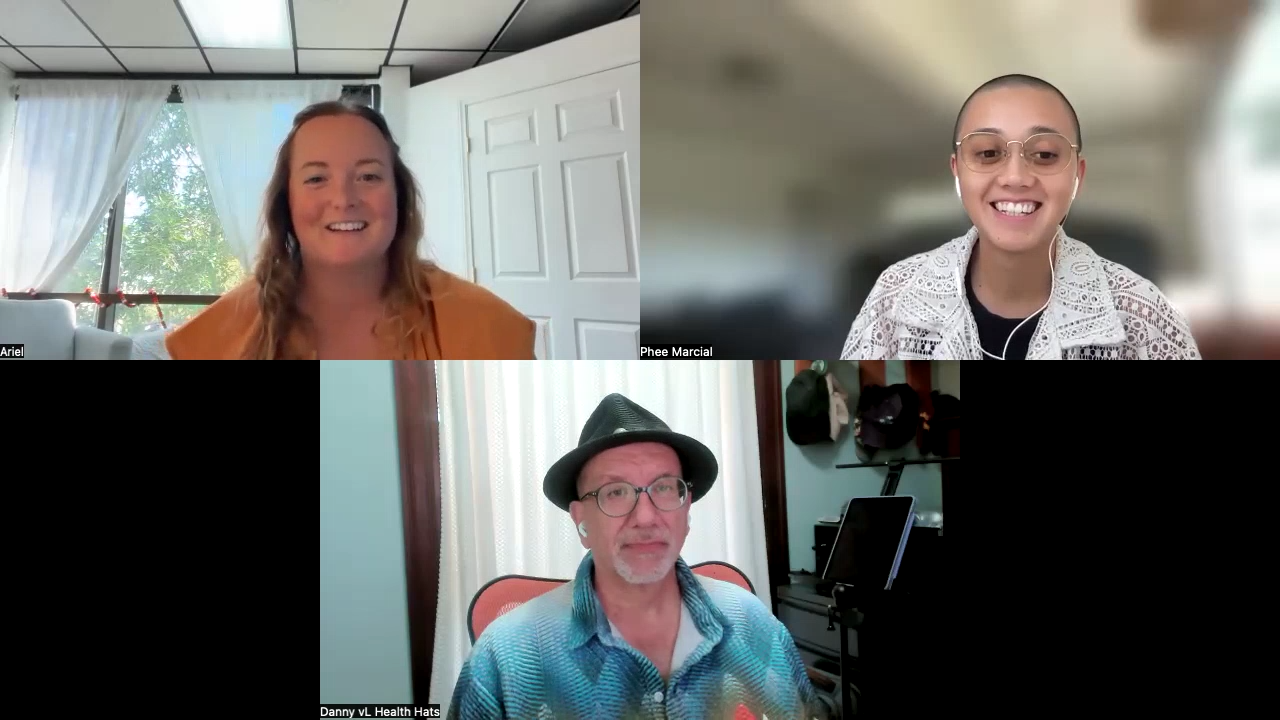
Pelvic floor physical therapist Ariel Gallop joins Phee and Danny on endometriosis: a whole-body disease, missed diagnoses, and patients’ self-gaslighting.
Click here to view the verbatim transcript
Click here to read the newsletter
Summary
In nursing school, Ariel Gallop was taught to add two drinks to whatever patients admit to and subtract two points from whatever pain they report. She became a pelvic floor physical therapist and does the opposite: she listens. Phee and Danny talk with her about endometriosis as a whole-body disease, why GI doctors almost never name it, why patients talk themselves out of a diagnosis (“that’s way worse than what I have”), and who should be doing the research. Her pearls: find your community, trust your body, keep fighting, even though you shouldn’t have to.
YouTube Podcasts
Contents
Episode
Proem
Health Hats: My grandson just started nursing school. His favorite class is anatomy and physiology. “I’m learning the insertions of the bones. That’s where tendons and ligaments attach to bones. Am I ever gonna use this knowledge?” Half an hour later, he says, “The body has amazing orchestration. So much to manage.”
That insight gave me tingles. I replied, “Yes, when and where it works.”
Endometriosis feels like musicians scattered across sections, not feeling the beat or following the conductor. It’s hard to hear the tune with musical confusion in the foreground. I have no health experience to draw on to understand endometriosis. The music analogy feels like a smudged window.
Welcome to another episode of Endometriosis with Phee. Learn with us. Come with any level of knowledge or ignorance. Hear the blend of fear, pain, disappointment, awe, defiance, and hard work.
Pelvic floor therapy
Phee Marcial: Hello, Ariel! Thank you so much for joining us for this Health Hats podcast episode. We’re super excited to interview someone with extensive clinical contact time with patients with endometriosis and to get a sense of your experience with pelvic floor therapy in general and with the endometriosis community specifically. You’ve been such an incredible resource to me from the beginning. I gushed about you in the first episode, so—don’t worry about it too much—
Ariel Gallop: Aw, thank you! No pressure…
Phee Marcial: You were also the only person I felt I could reach directly on a shorter timeline, because I was on all these waiting lists and had no idea when I was gonna see somebody. So to kick things off: maybe I can ask you to introduce yourself a little bit and tell us what you do. And imagine there are some of us who have no idea what pelvic floor therapy is, and some of us who may have some experience with it.
Ariel Gallop: Oh, yay. Okay! Cut me off if I go too far, because this is my passion, you know that! Okay, so I’m a pelvic floor physical therapist. What that means is I went to college, then to PT school, which is three years, and after that I did additional training to become a pelvic floor-certified therapist. You don’t have to do that to be a pelvic floor therapist, but that’s how people get the extra letters behind their name to say, “Okay, you really are a pelvic floor PT.”
So what that means is I look at the whole body. I’ve been trained to look at the whole body. I can treat someone’s neck. I did that this week. I can look at someone’s foot and say, “Okay, you need someone to look at this,” and it’s not me. I’m not so great with the feet, but I can treat the whole body. I look at the whole body, and people most of the time are coming to me for pelvic dysfunction. And I say, “Okay, is this going on in the pelvic floor and causing ripples up and down the chain, or is this happening somewhere else and that’s affecting the pelvic floor?”
Sometimes people will come in—I have someone right now who is coming to me for urinary leakage—and there is some pelvic floor dysfunction. I think it’s coming from poor ankle and foot mechanics, which is affecting the knee and the hip. So, as pelvic therapists, we can treat everything—
Health Hats: Can I ask you a question?
Ariel Gallop: Please.
Health Hats: What is the pelvic floor?
Ariel Gallop: Ooh, good question. Thank you for asking. Okay, so the pelvic floor is the group of muscles inside the pelvis. There are three layers of muscle there. They each have their own function, and they also work together.
The first layer is very superficial. It’s very pleasure-related, but it also helps with urinary functions. The second layer is very urinary-related. The first layer also helps with pooping. The third layer holds everything in and supports urinary, bowel, and pleasure functions—but the deepest layer can also affect the mechanics of the hip and the tailbone. And so when someone is coming to a pelvic therapist, they should be looking at each layer to see, okay, what’s going on in these muscles very specifically? Is this your bulbocavernosus on the left side affecting things? And then also: how is that affecting things up and down?
Good question about what the pelvic floor is! We treat the pelvic floor and the muscles it includes, along with any symptoms they’re causing. Sometimes I think the simplified version of what people think of is, “I’m having urinary leakage,” “I’m having constipation,” or “I’m having pain with intimacy.”
It definitely is those things, but it can also be more than that. So, a lot of times it is those things in combination with, “Okay, I am going to poop, but not everything is coming out,” or, “I’m going to pee, but I don’t feel empty, so I’m going four times an hour.” Some of what a pelvic PT does is the mechanics, working on the muscles and bones, but also the behaviors. So that, in a nutshell, a very wordy nutshell, is pelvic floor therapy.
Tissue drama
Phee Marcial: I guess my next major question is about endometriosis, your relationship to it, and how you came to be in this space with the endo community. I know a little bit about this, but I would be very curious to hear. You always ask at the support group what people’s first experiences with endo are, and I wonder what that is for you personally, as well as in your work.
Ariel Gallop: Oh, I would love to talk about it. In my work, I got into pelvic therapy—I just—I think it’s really interesting—I got into it because my friends were having pain with intimacy, and I learned in PT school that we could help with it. I honestly thought I was gonna work with kids my whole life, and then I learned about pelvic therapy, and I was like, “This is very cool. This can help my people,” and it just felt so right. So they were throwing me the people who had pain. And so I got to see the craziest diagnoses and start to learn the things that aren’t just the stuff you learn in the book. “Okay, these are the classic things, these are the classic presentations, but what if someone doesn’t fit any of that?”
And I did my own research because there just weren’t people who were really talking about it. And yeah, I just started getting more into the pelvic pain world. And then when I started my own practice, I just wanted to see what San Diego had to offer—what people needed help with, specifically pelvic pain—and I kept seeing people with pelvic pain who weren’t getting answers. Every doctor was saying, “You’re totally fine. You just need to use more lubricant or drink more alcohol or have more sex, and then it’ll be better,” which is insane and still happens. But I started to really attract people with pelvic pain because it was my passion, the thing I got good at, and the focus of my education and research. And so I started attracting people with pelvic pain and began recognizing patterns that weren’t the classic ones.
When I first got into pelvic therapy, we were really only taught that if someone’s having pain with sex, that is—or not pain with sex, but painful periods and maybe painful sex—that is endometriosis. And then when I started working in this setting, I started putting it together a little bit better and seeing that there is a big bladder component, and that might not even have any period components.
Or there’s a huge bowel component, and everything can look totally fine, quote-unquote, on a colonoscopy and an endoscopy, and they still have symptoms, and that is still something. And I started piecing it together and really seeing, okay, this is endo.
Health Hats: I’m still—I’m working on the basics. Okay. So, like, Kegel exercises—are those pelvic floor exercises? I’m trying to picture—what is an exercise? That is, a pelvic floor exercise.
Ariel Gallop: When people come to me with—there are two pathways in my head for treating people in general. If someone has a weakness or tension—and you can have weakness causing tension, but we won’t get into that—but if someone has weakness, we do strengthening—and that can be a KAY-gul or a KEY-gul; they’re interchangeable—but basically a Kegel is: you contract the pelvic floor, so the muscles of your vagina or penis or butthole, and you squeeze and lift those. And that is very helpful if someone has symptoms and sees that they have weakness, symptoms of weakness, like urinary leakage or leakage of their gas or their poop.
Kegels get a bad rep because a lot of people are told by physicians who aren’t looking at the pelvic floor muscles, “Do 100 Kegels.” That’s something I’ve heard over and over again, “Just do 100 Kegels a day and you’re fine.” And Kegels are appropriate for some people, but doing 100 of anything a lot without someone actually looking at it is not great.
So sometimes Kegels are appropriate, and they are pelvic floor exercises. But sometimes it is more—it looks more like hip-strengthening exercises. So a deadlift, a Russian deadlift, carrying weights on one side of your body so you’re having to stay level, or lunges. So there are a lot of things that can be pelvic floor exercises without doing a Kegel, but a Kegel is a typical exercise that people think of with pelvic therapy.
Health Hats: Okay.
Ariel Gallop: When people have pain or tension, I want to address that before we start strengthening those muscles. So, a lot of times, with anyone who comes to my clinic, if they consent, I do an internal pelvic exam, which might be vaginal, rectal, or both.
And I want to see, okay, what do the muscles feel like and what is their coordination? So if I have something intrarectally and I say, “Okay, can you squeeze my finger?” I want to see whether it squeezes, whether it’s strong, whether it’s coordinated, and whether it’s symmetrical on both sides. If I say squeeze, does it squeeze? If I say let go, does it let go?
I also do a lot of visceral mobilization. I call it abdominal massage, but we find tight organs or parts of the abdomen and mobilize them. I think that tends to be very helpful for people with endometriosis. If it’s on someone’s bladder, we can gently move that bladder and say, “Okay, there might be an adhesion here, or there might be a scar here,” or we just know there’s tension on this side because it’s not moving as well. Can we gently move it to the other side of the body and show the body that, okay, you can move here, and this is not causing tissue drama—trauma? So, a lot of massage.
Health Hats: Thank you.
Ariel Gallop: Yeah.
Piecing it together
Phee Marcial: I guess moving a little bit more into big ideas and the broader scope of what you do, including the state of care for endometriosis patients at the moment.
PTs are offering day-to-day care for people with chronic conditions that are often otherwise deemed inexplicable or untreatable, as you were already saying. And I guess I’m curious about how you work with stigma around this condition and around pelvic floor and women’s health in general. A very big and complicated question, but yeah.
Ariel Gallop: I would love to talk about it. I think that as… I will get to your question, but I think pelvic PTs in general come from a really cool place in that we see people who come for pelvic issues, and that could be bowel issues, bladder issues, intimacy issues, or maybe someone has the diagnosis of endometriosis. But we see so many different things, whereas most providers, most physicians, are going to say, “I treat the bladder. I treat the bowels. I’m going to do a colonoscopy and an endoscopy.” Whereas I see people who have bladder symptoms, bowel symptoms, and pain with sex, so I am seeing a very holistic view of a person. Whereas most providers just don’t have the time, simply put.
I think PTs in general come from a really cool place where we get to see a lot, and we get to have a very holistic perspective and education. And because of that, I’m able to work with people much more specifically.
I think, in regard to the stigma, we know that women’s health is just not researched enough. There are things we’re finding out just this year about sleep, iron, and protein that should’ve been figured out forever ago. So I think it’s hard to navigate the medical system in general when a diagnosis is so under-researched. Yeah, I think it’s a hard world to navigate.
I really work hard to know everyone in San Diego who might be helpful to my patients. I think endometriosis is so often undiagnosed or misdiagnosed because people only think of it as really painful periods, and it can be that, but it can also be so many other things. So I think really looking at the whole person and hearing their whole story has really helped me navigate this tricky world of women’s health, pelvic health, and endometriosis specifically.
First, we listen
Health Hats: So, you’re talking about the stigma and the attitudes that clinicians bring into this world, and then you’re trying to find the partners who are a constellation of people you can call on when you have a patient. Now, do your patients also come in with their own stigmas that—yeah, ’cause we all have—
Ariel Gallop: Yeah. Totally.
Health Hats: I do. We all have something. For me, as a person with chronic illness, the challenge has been, okay, this is how I am. I love myself. And what are my strengths, and what are my challenges, and how am I going to build on my strengths and deal with my challenges? But I have my own attitudes that I came into this with that I have to deal with. So do you find that—are you the savior? Or somebody said, “Here’s somebody that might be able to help you,” and they’re like—they’re not really ready for you?
Ariel Gallop: That is such a good question. I think a lot of people come to me not having any diagnosis. I think that’s often the case, and I’m the one saying, “Hey, this really sounds like this. What do you think? Does that resonate with you?”
If people come in and they have a diagnosis, most of the time they’ve been given the appropriate diagnosis, and they were treated by the appropriate provider, probably the endometriosis surgeon, and then sent to me. So they really do already have some buy-in, I think, in general, when they’re seeing me.
I think that it would make sense if someone had a chronic illness for them to come in and not have a lot of hope about what we can do, because so much of the healthcare system has failed them over and over again. I would like to think that I create a space where they can say, “Okay, these are your goals,” and I say, “Okay, these are the realistic things that we can work on,” and they have some belief that we can work on those together. But I think that, yes, everyone does come in with some kind of bias, and it is tricky to navigate, but it is fun to navigate.
So, when I went to college, my bachelor’s degree ended up being in human health sciences, but I thought it would be fun to be a nurse, too, which is just an incredibly hard major, and I didn’t stick with it because it was too hard for me.
But when I was in nursing school, they taught us that if someone says how much alcohol they’ve had, you need to add two drinks to that per week, and if someone says they’re in pain, you need to take away two pain points from that. And I think that’s outrageous and inappropriate. But I think that’s a lot of the healthcare system, so I go in every day trying to remember that if someone is new here, this might be the most important thing going on in their life. I might be the first person talking about a pelvic exam. I might be laying it on them that I think they have a huge diagnosis. And I try to come into the room respectful of all those things, knowing that’s how they’ve been treated by so many providers. So, I would like to think—and I try to make this a space—where people can really be heard, because I know there’s so much not… so many providers not listening.
Health Hats: Thank you.
Doing it for yourself
Phee Marcial: Yeah. I can speak to my own experience with you specifically, Ariel, and to endometriosis in this area in general. The stigma around women’s health and gynecologic conditions is so extreme that, as a patient, I don’t even recognize that certain things are making it harder for me to access care, even though I wasn’t thinking about them before. And I think being in regular pelvic floor therapy has really changed my relationship to my body in a way that is necessary for navigating the medical industrial complex otherwise.
I obviously won’t speak for other patients, but I wouldn’t be surprised if this is true for a lot of your patients and a lot of people who see PTs in general: it forces me to be with my body and be with my pain in a way that I have to set aside in the gynecologist’s office, for example, to try to explain what’s going on with my body in the most intellectual, factual terms as possible.
Not that we don’t talk intellectually in your office, for sure. I think the majority of what I’ve done to try to learn more about my condition and to deconstruct some of the stigma I carry around it has been in your office. But I also never thought my body needed the kind of attention it gets in PT, if that makes sense. And physical attention. We are working very specifically on my body. I’m having to think about how things feel when you’re doing a certain type of exercise with me.
Ariel Gallop: I think that it’s the coolest thing. I love being a part of it. I love what I do. But I think you’re right. I think it’s nice for people to feel like they’re taking an active role and they’re actively doing something that is going to make them feel better or even move better, even if they don’t 100% feel better. It is doing something you can say, “I did that for myself.” There is a little bit more autonomy in doing physical therapy. You’re saying, “Okay, I’m going to go, and I’m going to do this, and it might not always feel awesome, but it is doing something to make things better and a step in the right direction.”
Phee Marcial: Yeah.
Ariel Gallop: I do think especially with endometriosis, but anyone with a chronic condition—and especially a chronic pain condition—I think that people so often are forced to gaslight themselves or brush off their symptoms or lessen them, that people will even come into my office and I might say—I had this happen twice this week—I said, “I think that you have endometriosis. I think this is something that we need to talk about and you should dive into.” And one time someone said, “Oh, no, I know people with that. That’s way worse than what I have.” Or they say, “I don’t have the classic symptoms, so I don’t have that, so let’s just move on.”
So, I think that people often are brushing off their symptoms and trying to lessen them because our system really does force that: if it doesn’t fit into this perfect box, then you’re crazy. The word endometriosis used to be hysteria for women, so—I think we are in a time where people are hopefully seeing that word more and seeing people getting better and seeing improvement with it, and it really is an honor to be a part of. That’s the coolest part of my job. Getting to go alongside people and be a part of their journey and say, “Okay, this is what I know. This is what I can connect you with,” and just walk alongside them as much as I can.
And you’d said earlier that I was the person with the shortest wait list, and it is—it’s true! —because I really try to keep spaces for the things I love. But also, yeah, I’m not a surgeon that’s booked out until next May, so it is easy for you to get in with me. I want people to text me. I got a text at 4:22 in the morning, someone saying, “Oh, I—this is going on. I think we should work on this next time,” and I love that part of my job. I love being along with people on this journey.
A network of resources
Phee Marcial: Yeah. I think it is so amazing that you do what you do and that you are so passionate about it. I feel extremely lucky. And I’ve learned so much from you about not just my condition, but how to navigate these types of conversations with other women. And it is a very fine balancing act, I imagine, between trying to have a meaningful connection with a person and really trying to make the kind of care that they need happen for them.
Ariel Gallop: Oh, yeah.
Phee Marcial: But I, yeah, this is another major point for me: you’ve served as a liaison between me and so many patients, and this huge—feels like an explosive network of different resources. And whether that’s a specific provider, a website, or a product I can use—the pelvic wands, the CBD suppositories, right? It is clear that you’re always trying to learn about different things that could be helpful in any way, and it doesn’t really matter what that thing is: it gets wrapped into the network anyway. So, there’s just so much synthesis work going on there.
But I am curious: you are extremely discerning about what you recommend, who you recommend it to, and why. So I’m curious about how that role feels for you, how you’ve come into it, how you maintain it, and what makes a good provider, especially in the endometriosis space.
Ariel Gallop: Ooh, great question! You mentioned earlier how I first interacted with endometriosis. As a pelvic PT, it’s a term that’s floated around, so we should—especially as new pelvic PTs—know the term endometriosis. But when I hosted my first endo support group, I was curious: when was the first time I’d learned about endo?
I personally have never had a patient whose GI physician said, “I think you have endometriosis,” based on their symptoms. Never. Ever. And I will say most people—not everyone, but most people—that come into my office don’t have a diagnosis, but they’re coming to me, and I’m saying, “I think you have endo,” because they have a GI diagnosis, or GI symptoms of endo.
So, all that to say: I think there’s not enough education in the healthcare system about endometriosis, and that’s obvious from everything you’ve said in the past and today. There’s just not enough research. So I have to do my own research on who is a good provider and what is a good product. I created this networking group in San Diego for people who might be helpful, and then I meet with them one-on-one and talk with them. I talk their ears off about endometriosis because it’s my passion. And then I wanna hear: what do they know about endometriosis, and how many of their clients have endometriosis? How much are they willing to learn about endometriosis? So, I’m meeting with acupuncturists, chiropractors, and therapists, talk therapists. Any provider that might be helpful, I meet with them one-on-one and in a group setting to learn: what is their current education, and how much are they willing to learn? And then I talk to them more about what I want in a provider who does what they do. And then, depending on how receptive they are to that, I might refer people.
There are lots of people who do acupuncture and treat fertility issues, but do they know about endometriosis? Are they a chiropractor who knows how to treat the pelvis? Okay, great, but do they know endometriosis? So, I really do vet my people, and it does take a lot of time, but it’s such a pleasure to do and to know, okay, this is a good person.
Research: a conundrum for patient advocacy
Phee Marcial: There’s such a lack of good information out there that we all have to talk to each other and hear what other people have to say.
For example, when I started low-dose naltrexone for inflammation, I had no idea what side effects to expect or how my body would adjust to the medication. It helped a lot to be able to talk to you about patients you had who had very recently taken it, and the same with other providers I was seeing. It’s just not research that’s been done. So I think being able to see those patterns is such a skill and something that a lot of patients really need from providers right now, especially with conditions where there is stigma or a lack of research for whatever reason.
Ariel Gallop: It’s fun to be a part of. It’s cool for me to do the research. It feels like a frustrating burden for patients that they shouldn’t have to go through. It shouldn’t be that y’all have to do the research. This week there’s news of a peptide that might be helpful for endometriosis and for getting rid of it so that people don’t need to have surgery. I had literally—I counted—seven people this week alone send me a message on Instagram or a text about it and ask my opinion. Seven different people who were like, “Hey, what do you think of this?” And I’m glad that they’re asking, but it shouldn’t be that they have to be doing that research. It shouldn’t be that they’re like, “Wow, I found this new thing.” It should be that every provider already knows it. And I think, especially with endo, so few providers really do know it. So few people know about the metabolic and hormonal components, and so patients are having to do their own research. But yes, we’re not there yet.
Health Hats: I have a couple of reactions. Using the word “should” is a red flag for me. Because it’s the way it is. And what you’re doing is a step towards that; when information is lacking, why shouldn’t we do the research? Like, where does research come from?
I do think that’s an important part of what you’re talking about. There’s a tremendous opportunity here for activated people to learn together. And how do things become scientific? You get it because somebody wants to know.
Ariel Gallop: Yes.
Health Hats: Yeah. And then you can do something like you did, with a slightly different passion. Your passion is about treatment.
Ariel Gallop: Yeah.
Health Hats: And so there are other people whose passion is gathering information systematically. That way, you can look at it, understand it, and then you have a network to share it with, both clinicians and patients. So I think that’s really exciting.
Build a community, trust your body, keep fighting
Health Hats: The thing that I would like to know from you in terms of wrapping this up is that you’re learning a lot in your practice. And there are certain things that are unique to endometriosis, and then there are factors that are general.
Pick three things that you think are key to communities that are in this stage of learning and coming together. What do you think are key for them, based on your experience with your practice?
Ariel Gallop: That’s a good question. I think that finding people that have similar presentations to you, and then y’all can work together as a, “Okay, this has worked for you, this has worked for you,” creating a community and building off of what each other—what y’all have learned together and separately—and using that to move forward, I think is a really—I think the answer to that is community. I think community is very important.
What I would want my people to know—and anyone, really—is that most patients know their bodies best. I would really want them to lean into that and trust it. And if you’re not getting answers from someone, then find someone new. I know it’s frustrating; I hear that over and over but keep standing with that because you do deserve to have the answers. And I think you know them. Even if you don’t know the name for it, I think people know it internally. And so I’d love for them to keep powering through as much as they can.
I really want to always encourage the people I see to know what’s going on with them, be direct, and fight for it. And I said earlier that people shouldn’t have to do the research; providers should just know and provide solid research. I want people to be educated and to know what’s going on with their bodies, but they shouldn’t have to. We should have enough research to know these things. I feel that way about this. You shouldn’t have to fight for stuff, but I want you to because I want people to get answers, and we don’t have a healthcare system where they don’t have to fight for it. So, I think: build a community of people who get it, trust yourself, and keep fighting for it because you deserve answers, and I think there are people out there who can get them to people.
Stay vigilant, ask questions
Health Hats: Thank you for that. That was fabulous. You got two minutes: what did we miss? What should we have discussed that we didn’t?
Ariel Gallop: I think the thing—if I am thinking just about endometriosis in general—is that most physicians and even most patients, when they start this journey, are really just thinking painful periods.
And it can be that, but it can be so much more than that. And if people are experiencing things that don’t make sense or aren’t getting better with traditional methods, like, “Oh, maybe you have interstitial cystitis,” and we’ve done all the instillations, and it’s not working, maybe it’s something else. And can we look at something else that might seem crazy? Because I think endometriosis, to me, presents in so many ways, and it really is a huge puzzle: okay, you have this metabolic thing, and you have this period thing, and let’s kinda link those and see if it makes sense.
So I think that is the endometriosis thing that I don’t know if I stressed enough: make sure you aren’t just saying, “Oh, because I don’t have this symptom, it’s not this.” So much of what I see, endometriosis and everything, is not just the textbook answer.
Phee Marcial: Absolutely.
Health Hats: Thank you. Wow.
Ariel Gallop: Thank you for listening.
Phee Marcial: You’re so cool, Ariel. Thank you for doing this!
Thank you so much for joining us today. Up next, we will be talking to a researcher who has endometriosis herself and studies it. She is from Switzerland, and her name is Océane Pittet. Please look forward to it.
References
Phee Marcial’s website: https://hvmator.com/home
From Ariel
Inspired by and Grateful to:
Laura and Fred Marcial, Chandra Spring-Robinson, MD, Alyssa Yee, MD, Ariel Gallop
Related Episodes
The Gods Fight: Intro to Endometriosis Series w Phee Marcial
Please comment and ask questions:
- at the comment section at the bottom of the show notes
- on LinkedIn
- via email
- YouTube channel
- DM on Instagram, TikTok to @healthhats
- Substack
- Patreon
Production Team
- Kayla Nelson: Web and Social Media Coach, Dissemination, Help Desk
- Steve Heatherington: Help Desk and podcast production counseling
- Joey van Leeuwen, Drummer, Composer, and Arranger, provided the music for the intro, outro, proem, and reflection
- Claude, Perplexity, Auphonic, Descript, Grammarly, DaVinci Resolve, DaVinci AI Art Generator, OpenArt AI Creator Studio
Artificial Intelligence in Podcast Production
Health Hats, the Podcast, utilizes AI tools for production tasks such as editing, transcription, and content suggestions. While AI assists with various aspects, including image creation, most AI suggestions are modified. All creative decisions remain my own, with AI sources referenced as usual. Questions are welcome.
Creative Commons Licensing
 This license enables reusers to distribute, remix, adapt, and build upon the material in any medium or format for noncommercial purposes only, and only so long as attribution is given to the creator. If you remix, adapt, or build upon the material, you must license the modified material under identical terms. CC BY-NC-SA includes the following elements:
BY: credit must be given to the creator. NC: Only noncommercial uses of the work are permitted.
SA: Adaptations must be shared under the same terms.
Please let me know. dannyhealthhats@gmail.com Material on this site created by others is theirs, and use follows their guidelines.
Disclaimer
The views and opinions presented in this podcast and publication are solely my responsibility and do not necessarily represent the views of the Patient-Centered Outcomes Research Institute® (PCORI®), its Board of Governors, or Methodology Committee. Danny van Leeuwen (Health Hats)
