
Podcast: Play in new window | Download (Duration: 38:36 — 30.9MB) | Embed
Subscribe: Apple Podcasts | Spotify | Email | RSS | More
Studying the disease you live with brings control, discouragement, & responsibility. Researcher Oceane Pittet, with lived experience, holds both roles.
Click here to view the verbatim transcript
Click here to read the newsletter
Summary
Endometriosis varies so much, with pelvic pain, fatigue, infertility, and comorbidities in about 95% of patients, that Oceane chose a participatory method for her study. Photovoice puts a camera in participants’ hands: women photograph parts of their experience, write about the images, and discuss them in focus groups. In one participant’s photo, a woman stands before Lake Geneva holding a buoy made of everyone and everything that keeps her afloat. In another, titled “Chaos,” a flare-up the night before an important workday leaves her crying on all fours. Together they show what pain scores miss: the invisible work of holding a life together, and how fast the disease can take that control away.
Oceane lives with the disease she studies. Understanding it has made it feel less mysterious and given her more control, but it has also shown her how little research has been done compared with how many people it affects. In focus groups she often wanted to say “I totally feel you” and had to stay in her role as moderator, with support from a patient partner and her supervisor. She says honest self-reflection is essential in qualitative research. Her bottom line isn’t about herself: it’s about the women who trust her with their stories, and showing clinicians and policymakers that we aren’t doing enough yet.
YouTube Podcasts
Contents
Episode
Proem
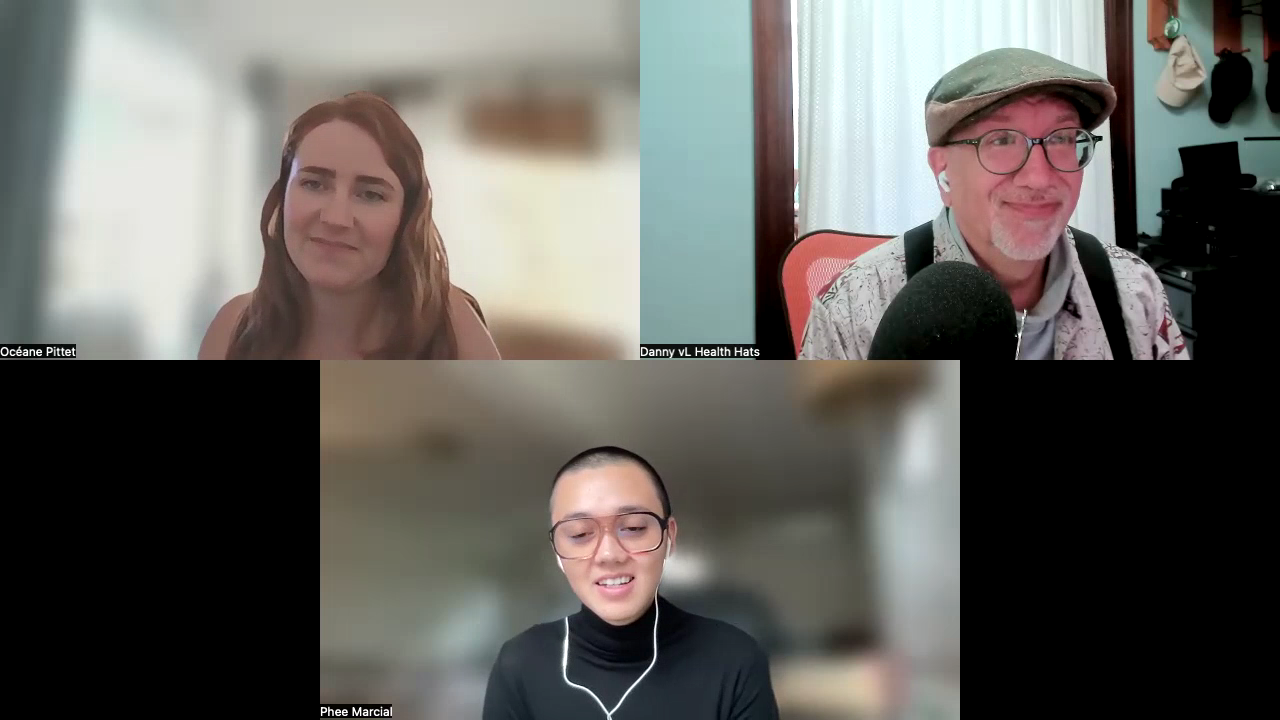
I met Oceane Pittet at the 2026 Camden Coalition’s National Center for Complex Health and Social Needs conference, Putting Care at the Center. She spoke about her endometriosis research. I texted Phee; should I invite her to be a guest? Of course! My interest was piqued on several levels. A researcher with lived experience, an early-career researcher, a person from another country, and the Photo Voice methodology for listening to research participants. Let’s jump right in.
No Periods, No Pain, No Problem?
Health Hats: When did you first realize health was fragile?
Oceane Pittet: I have endometriosis. I think I realized quite early that something was wrong with my health. And so I had very painful periods from a young age, basically from the time I first started menstruating.
And I remember talking with my friends about it and realizing that they weren’t experiencing the same thing. And yeah, when you’re in so much pain that you’re basically vomiting, you realize that this isn’t happening to the other people around you. You start to understand that maybe this isn’t normal.
Back in the day, I spoke with my mother about it, and she took it seriously. I made an appointment with a gynecologist, but at that point, endometriosis was never mentioned. I was simply prescribed the contraceptive pill to stop my periods, and that was essentially it.
No periods meant no pain, and the problem seemed kind of solved. Or at least it was hidden. And it was only much later, when I was, I think, around 18 years old, that I first really heard about endometriosis and started reading about it, looking at the symptoms. And I remember thinking, “I tick every box.”
And I think that was really a turning point for me. After that, I started researching specialized endometriosis centers, and I went to one of these centers to see a specialist in endometriosis. Even before thinking about treatment, simply having an explanation for what I had been experiencing for all these years made a huge difference and helped me understand my own body.
And yeah, I also realized that the pain I experienced from such a young age wasn’t something I was simply supposed to accept as part of being a woman.
Health Hats: Wow. Thank you.
Phee Marcial: Thank you for sharing.
A Decade to a Diagnosis
Health Hats: Phee, do you want to introduce yourself?
Phee Marcial: Yeah. It’s great to meet you, Oceane. I’m Phee. I’m an artist and illustrator. I met Danny through my mother, who’s in the health informatics space. He’s like an uncle to me. I’ve heard him a lot on calls throughout my childhood, and I’ve heard about him from my mom. But we came together for this project about endometriosis because I was officially diagnosed last year after a decade of trying to figure out what was going on with me. It was almost beat for beat like what you went through, getting put on birth control at, I think, 13. Yeah. And just the lack of information available to me and my family made it really difficult to even start talking about endometriosis, let alone get a diagnosis and the kind of treatment I needed.
Grappling with Gaps
Health Hats: Do you want to talk a little bit about your research?
Oceane Pittet: I have a background in psychology. I worked for a few years on a project to promote patient and public involvement in research and health projects. Last year, I started a PhD on this project, focusing on endometriosis. More specifically, this research aims to develop and evaluate a care team interface for health professionals and a patient decision aid to help patients compare different options for managing endometriosis symptoms and make informed, value-based decisions together with their healthcare providers.
The goal is not to replace the healthcare provider. We want to consider both medical and non-medical approaches, as well as fertility preferences and goals. So maybe I can say a few more words about what a patient decision aid is.
Health Hats: Yeah.
Oceane Pittet: The patient decision aids are evidence-based tools. They are designed to help patients make specific, deliberate choices among healthcare options. As I said earlier, they are intended to supplement, rather than replace, clinicians’ counseling about options. They differ from usual health education materials because they state the decision to be made and provide detailed, specific, and personalized information on available options and their outcomes to support decision-making.
Because endometriosis has no cure and there are many different treatments, there is no gold-standard treatment. That’s why we thought it was important to provide evidence-based information and a patient decision aid to help women with endometriosis make informed choices.
Prevalence and Burden
Health Hats: We can’t say there’s a ton of research out there about endometriosis. When you say evidence-based, it must be challenging because if you’re going for the evidence and much of it isn’t there, what do you do with a decision aid when the science has gaps?
Oceane Pittet: Yeah, that’s a good question. At the research level, endometriosis as a whole remains significantly under-researched, especially given its prevalence and the burden it places on patients.
Health Hats: Yeah, so prevalence and burden.
Oceane Pittet: We estimate that 10% of women of reproductive age will have endometriosis, so that’s huge. Huge. That’s really huge. And the impact on quality of life is also really huge. And it’s also a chronic disease, so you can have it your whole life, even after menopause.
We have more and more research on that because, not long ago, we thought that you could only have endometriosis from when you start your periods until menopause. But that’s not entirely true. And as I said earlier, there is no cure and no gold standard treatment, so you have to find what works for you and a treatment that fits your goals, whether it’s to reduce pain or to have a child. It really depends on your goals, and it’s also very preference-sensitive. If you do not want to take hormones or have surgery, that’s important to consider. So, it’s really important to hear from the patient and what she wants to do. But yeah, the problem is that, indeed, it’s still under research.
So as of today, we have some guidelines, but we still lack some information and research. The goal will be to take everything we have so far and put it into the patient decision aid. What I didn’t say earlier is that it will be a chatbot, specifically an RAG chatbot (retrieval-augmented generation, I think is the acronym). We will feed the chatbot with information, and it will give this information back to the patient in a more understandable way. The advantage is that the chatbot can, for example, speak in the patient’s language. It’s always available, and the patient can say, “Oh, I don’t know, I don’t want to take the hormonal pill,” or “I’m afraid of these side effects,” etc. And the chatbot can help the patient understand what kind of treatment could be the best option for her.
So it’s difficult to find funding for endometriosis research today, at least in Switzerland, and I think that in the United States it’s maybe not a perfect time for this kind of research, I imagine. It’s always astonished me that a lot of research is on the partner’s experience, even though we still lack a lot of research on the patient. But there is a lot of research on how partners experience the fact that their wives have endometriosis and have difficulties having sex or things like that.
It’s crazy, and it’s also about fertility. But more and more research focuses on quality of life and patients’ pain, and that’s encouraging. For example, in Switzerland, we have a very strong association for endometriosis, and they really try to push the government to do something about this disease. As we said earlier, it’s crazy how prevalent it is. 10% of women, it’s huge.
The Stars Aligned: Getting Funded
Health Hats: So maybe we should say here that you live in Switzerland. That might be an important fact for people to know. So, when you think about research, first, there’s a supportive place to do it. You had two presentations at panels, and there was somebody there who was clearly rooting for you. And I got the sense that this might be somebody you were working with. How did you find a supportive place to do this research?
Oceane Pittet: Yeah, absolutely. I was already working with this person on this project to improve patient involvement in research. Her name is Marianne Durand. She’s a professor at the University of Lausanne in Switzerland and at Dartmouth College. She’s really interested in participatory methods and women’s health. She’s a very nice person, too.
Health Hats: So, that really helps, doesn’t it?
Oceane Pittet: Absolutely. And that’s why I decided to try to find funding for this project with her, because I knew she would be supportive and that it would be a subject she would be interested in. And so we submitted some proposals to different grants in Switzerland, and we had the chance to get the biggest one, so it’s from the Swiss National Fund. I was a bit astonished because we had this grant on the first try, and it’s not easy to get funding from them. But it was also because all the endometriosis associations were pushing to have a project studying endometriosis. For the last few years, no endometriosis projects were funded, so it was quite crazy. And so I think it was also a bit easier for us to get this grant, to be honest. So, we had some luck regarding this.
Health Hats: The stars were in alignment.
Oceane Pittet: Absolutely.
Not Wanting Kids Got Me Care
Phee Marcial: Yeah, that’s great. It’s always wonderful to hear stories of research getting funded right now. I think everybody’s in a place of hoping as much as possible for some luck. I know that, at least anecdotally from my patient experience, the research that my gynecologists are doing themselves, in addition to surgeries and patient care, is hard to imagine. It’s hard to imagine how they have the time for it and where the money comes from. The gynecologist who recently did my surgery gave a presentation at a conference about what you were saying regarding seeing endometrial scar tissue after menopause and the treatment plan she’s developed for these patients. And I thought it was really interesting that the motivation there is primarily about pain and quality of life, because a woman cannot have children after menopause.
Obviously, a complicated relationship for the individual, but yes, of course, across the board in research and in politics, between trying to improve fertility and trying to improve women’s quality of life.
I myself am not interested in having children, so that played a major part in my ability to get the kind of care I needed. It’s different for everybody, but I think if I had been struggling to get pregnant, for example, I maybe would have seen somebody sooner who had a better idea of what I had going on.
And instead, since I was dealing with a constellation of symptoms that were not specifically hallmarks of endometriosis, I was experiencing those symptoms, but I was also experiencing really severe GI problems and mood issues. And so I was seeing psychiatrists and gastrointestinal doctors, right?
And those people did not know how to point me in the right direction. I don’t think it was necessarily out of pure malice, but they did not have the knowledge to get me going in the right way. That definitely is an interesting change that I’ve noticed in research and in treatment, that there is at least among female doctors, all of my doctors are female, that they are interested in pain and in really trying to improve the long-term quality of life of an individual rather than specifically trying to orient around fertility.
I think that change over the past few years has really made it possible for me and a bunch of other people to get care. I don’t know that I would be where I am without that change.
Phee Marcial: And I imagine it also has to do with trying to suss out what the difference is between hidden prevalence and increasing prevalence. I wish I had better technical terms for these. I’m sure you could help me with this. It’s about whether people are under-reporting endometriosis or whether there are more people who have it than before. And that’s a very difficult thing to understand if we don’t have those numbers from prior years, right?
Hidden or Increasing?
Oceane Pittet: We still don’t really know why we have endometriosis, and it’s multifactorial. So genetics, but also the environment, can have some impact. Imagine if today it’s 10% and in 50 years it’s 20%. Why does this happen? Was endometriosis already a very prevalent disease 100 years ago? Is it the PFAS? Is it the thing we have in our environments that has an impact on this disease? So personally, this will be interesting information to understand further why this disease exists,
Health Hats: I get it.
A Community Born of Crisis
Phee Marcial: I can say that, at least for the individuals I’ve spoken with, whether they’re patients or clinicians, spreading the word is not enough. Being able to treat patients is the end goal. That’s what I’ve found in this community, and it is really wonderful.
It is a type of community that arises from crisis situations, right? So it is a complicated dynamic, but I’ve never met clinicians who are willing to try like crazy shit to get their patients the kind of care they need. That is a double-edged sword because you can be trying crazy stuff that doesn’t work, right? Yeah … and at the same time, there are a lot of people in this community who need that kind of, like I was saying- … creativity and who are desperate to learn more about their condition so that they can do more about it.
Health Hats: Yeah.
Phee Marcial: So I think it’s really cool that the project you’re working on, Oceane, is about patient advocacy from an educational perspective. The idea is to empower patients to have the agency to make their own decisions, or at least to make decisions together with a clinician, rather than feel like they are at the hands of a system that doesn’t know what to do with them.
Wearing Both Hats
Health Hats: Oceane, you’re a researcher and a person with lived experience, and I imagine that both helps you and creates challenges for you. So can you speak to that dynamic, whether you merge those hats you wear or distinguish between them from moment to moment?
Oceane Pittet: Yeah, I think that studying endometriosis has definitely changed my relationship with the disease. In some ways, it has given me a greater sense of control over it, and the more I understand the disease, the less mysterious it feels. And I think that knowledge can be very empowering, as you said earlier, Phee, especially when you’re living with a chronic condition. But at the same time, the more I studied, the more I realized how much we still don’t know about this disease, and how little has historically been invested in endometriosis research compared with the number of people affected by it, and that can be quite discouraging.
But as a researcher, I also find it incredibly motivating, and it makes me feel that there is so much work worth doing and so many questions that still need to be answered. Meeting and speaking with so many people with endometriosis through my research has, I would say, changed my perspective. It has made me realize just how many of us there are, and how many experiences feel incredibly familiar. There are moments when I hear someone describe something, and I just think, “I know exactly what you mean.” But at the same time, every person’s experience of the disease is different, and their symptoms, their journey, their diagnosis, their priorities, and the impact endometriosis has on their life can vary enormously.
Navigating that as both a researcher and someone with endometriosis can sometimes be difficult. For example, there are moments during interviews when I relate very strongly to what someone is telling me, and it can be quite emotional. You have to remain a researcher, but you’re also a person sitting across from someone whose experience may resonate deeply with your own.
Health Hats: Yeah. Wow.
Oceane Pittet: That has given me a very strong sense of responsibility. These women are trusting me with very personal parts of their lives and stories, and I feel responsible for doing justice to what they share with me. In a way, I also feel indebted to them, and it makes me want to ensure that the research we produce genuinely contributes something meaningful.
A Camera in Their Hands
Health Hats: Wow. I have to think about that. I’m really interested in the state of research methodology. Endometriosis poses many methodological challenges because we don’t necessarily have the methodology that is really good at handling the incredible variation.
Oceane Pittet: Because endometriosis is highly heterogeneous, you can have very different symptoms. You can have pelvic pain, dysmenorrhea, dyspareunia, fatigue, and infertility. 95% of women with endometriosis have one or more comorbid disorder. It’s crazy. So they have endometriosis, but most of them also have another condition. It is also a goal to include women with different kinds of symptoms and different kinds of experiences, and that’s what interests us – Yeah … to have this different kind of experience. And so we use participatory methods because they really give participants the opportunity to speak about their experience and to say what is important to them.
So that’s why we used this photovoice method. Maybe I can say a bit more about this method.
Health Hats: Sure. Please.
Oceane Pittet: Okay. Maybe one thing that is important is that, Phee, you spoke about the fact that we do art, and I think it’s important to clarify that we didn’t initially choose art simply as an alternative way of communicating scientific findings.
Art, or more specifically, PhotoVoice photography, was part of the research method itself. Essentially, you put a camera in the hands of participants. We invited women with endometriosis to take a photograph representing an aspect of their experience and to provide commentary on those images. The photographs then became starting points for discussion and reflection, and that discussion became part of the data we analyzed for our study.
Health Hats: Wow, that’s cool.
Staying the Researcher
Phee Marcial: Yeah, I was also going to say that’s, I imagine, a really good way to start a conversation about something that is extremely personal. I’m sure that’s one of the major reasons you wanted to do it, because it’s very hard to start a conversation about endometriosis with somebody. Even when I’ve had individual conversations with somebody, one-on-one, where I’m speaking to somebody who I know has the condition and she knows I have the condition, and we’re, like, on the same page, it takes a little while to start talking about it more seriously, because it’s still very stigmatized. In a lot of cases, I’ve spoken to somebody who’s told me that she’s never told anybody else what I’m hearing. I imagine that, in interviews, when you’re acting as a researcher, having somebody say that to you is very impactful. I see that you have a very strong sense of responsibility. Is it, was it too much? Did it get to be, like, really overwhelming at times? It would be overwhelming for me.
Oceane Pittet: Yeah. I totally agree with you, and that’s what’s so powerful about photo voice—it can really express experiences that are very difficult to put into words. For example—pain is very difficult. It was not easy to do that. We held focus groups with the patients. I was always with a patient partner and my supervisor. If I needed help, they were there. Sometimes it wasn’t easy, especially when I really related to someone’s experience. I wanted to respond, not as a researcher. I wanted to answer as a woman with endometriosis and say “Oh, yeah, I totally feel you,” or “Yeah, I had the same experience,” but I couldn’t. And it was a bit frustrating, to be honest. But I was taught how to manage a focus group, ask questions, and act as a moderator. It isn’t easy for everyone. Even my supervisor was a bit shocked because she didn’t know much about this disease. She also wasn’t aware of how much it affected this woman’s life. And when she heard their stories, she was shocked, a bit emotional, because she was like, “I didn’t know it was that bad.”
We also have to be conscious as researchers that we are human, that we have emotions, especially in qualitative research, and that we can be affected by certain stories. We have to take this into account when we interpret the data and when we write the articles. It’s important to have this self-reflection.
The Lake and the Chaos
Phee Marcial: I’m so curious about what kinds of photographs you were seeing and whether there were common threads.
Oceane Pittet: So we had a very different kind of photos, and some were very similar, so it was really interesting to see. But I have some extracts because we have the photos, and then each woman reads a short text explaining why they took each photo. So maybe I can read you an extract from two photos that really had an impact on me.
Phee Marcial: Yeah.
Oceane Pittet: So, for the first photo, if I can describe it a bit, it was a photo of a woman with an inflatable buoy. She was facing a lake. And so the text is only an extract. It’s a bit longer. So the text says, “Like a lake, endometriosis is invisible, mysterious, opaque, murky, and sometimes distressing. Sometimes it even repels me. Standing before the surface of Lake Geneva, I am confronted with everything I cannot see, with everything that lacks clarity. I need a buoy to keep me from sinking. That buoy is made up of my family, my friends, my lovely flat mates, my job and my colleagues, my psychiatrist, my contraceptive pill, my anti-inflammatory diets, the possibility of giving birth. Everything that allows me to feel a certain degree of control over my body, a control that rarely allows me to let go.”
Health Hats: Wow.
Oceane Pittet: And then there was another photo of this buoy, all shrunk into a ball. The title of this second photo was Chaos. “The feeling of being broken inside, feeling as though I’m poorly made. The flare-ups returned with the return of my period. After a year and a half on the pill, I wanted to get my cycle back, do- without the tablets, function without artificial aids. And then there it was. In the middle of the night, on the eve of a special and important day at work, when I felt I was indis- indispensable, the endometriosis reared its head. The pain was sharp and sudden. She holds me still. I’m crying on all fours on my bed. My stomach was knotted with anger. My hope was dashed.”
Every time I read this text. I find it incredibly moving. What strikes me is how clearly it shows the enormous impact endometriosis can have on someone’s life beyond the pain itself. And yeah, in the first text, you can see all the things this woman has put in place to keep herself afloat, and there is this whole ecosystem of support and strategies that allows her to maintain some sense of control and live something close to a normal life.
And then, chaos shows how fragile that balance can be. Despite everything she has put in place, the disease can suddenly reappear and take that control away from her. There’s the physical pain, of course, but also the anger, the disappointment, and the feeling of being betrayed by your own body. And I think that’s something some scientific paper can describe, but perhaps not make you feel in quite the same way as this text and these photos. Because in scientific papers we can measure pain scores, quality of life, work impairment, treatment use. But of course, these measurements are important, and this piece shows the invisible work behind those numbers, how much effort can go into simply keeping your life together, and how quickly endometriosis can disrupt it.
And for me, that’s really the power of these photographs and testimonies. They allow us to really understand, yeah, what these women experience in their daily lives in a very deep way.
Not About Me
Health Hats: Wow. What’s the bottom line you want people to take away from this experience, as both a person with lived experience and a researcher?
Oceane Pittet: It’s not really my experience. I think my experience counts, yeah, but I really want to show what women experience, like other women, and all the different experiences we can have, and how much this disease can impact their lives. And I really want to provide a window into what happens within this experience. So I think it’s interesting to also have the disease, but I think I’m not that important. It’s more the work that I do that is important for the women with this disease and to really show other people, not only the scientific community, but also policymakers, clinicians, and all the different key people, what this disease really is and the fact that we should do more because we aren’t doing enough.
Health Hats: Thank you.
Phee Marcial: Thank you so much …
Reflection
So much to digest here. Oceane said, ‘Or at least it was hidden.” A tragedy since I’m allergic to secrets. I’m intrigued by the chatbot built on thin evidence. Amazing potential when people with lived experience participate in developing it. The community born of crisis. Bringing creativity to clinical problem-solving, and to the question of where creativity ends and desperation begins. Finally, the cherry on top: The lake, the buoys, the chaos, and “the invisible work behind those numbers.” Pain scores and work impairment don’t capture what it takes to hold a life together, or how fast it falls apart. All from the Photovoice methodology. I need to see that in action!
Next, we’re scheduling an interview with Laura, Phee’s mom, and a session on gender roles and racial bias. I’ve been asked why I’m spending so much time on this endometriosis series with Phee. I’m having a blast collaborating with Phee; I’m learning so much, and the more I learn, the more I want to learn. And I can, it’s my podcast!
References
Phee Marcial’s website: https://hvmator.com/home
Photo Voice
- Wang, C., & Burris, M. A. (1994). Empowerment through photo novella: Portraits of participation. Health Education Quarterly, 21(2), 171–186. This is the earliest version of the method, from their first project in rural Yunnan Province, China, part of the Ford Foundation-supported Yunnan Women’s Reproductive Health and Development Program. photovoiceworldwide
- Wang, C., & Burris, M. A. (1997). Photovoice: Concept, methodology, and use for participatory needs assessment. Health Education & Behavior, 24(3), 369–387. https://doi.org/10.1177/109019819702400309. This is the paper most people cite. It covers how the concept developed, its advantages and disadvantages, key elements, participatory analysis, materials and resources, and implications for practice. It also sets out the method’s three goals: helping people record and reflect on their community’s strengths and concerns, promoting critical dialogue through discussion of photographs, and reaching policymakers. laibokejiphotovoiceworldwide
- Wang, C., Burris, M. A., & Xiang, Y. P. (1996). Chinese village women as visual anthropologists: A participatory approach to reaching policymakers. Soc Sci Med 42(10):1391–1400. umich
Inspired by and Grateful to:
Marianne Durand, Laura and Fred Marcial, Chandra Spring-Robinson, MD, Alyssa Yee, MD, Ariel Gallop, Kathleen Noonan
Related Episodes
Please comment and ask questions:
- at the comment section at the bottom of the show notes
- on LinkedIn
- via email
- YouTube channel
- DM on Instagram, TikTok to @healthhats
- Substack
- Patreon
Production Team
- Kayla Nelson: Web and Social Media Coach, Dissemination, Help Desk
- Steve Heatherington: Help Desk and podcast production counseling
- Joey van Leeuwen, Drummer, Composer, and Arranger, provided the music for the intro, outro, proem, and reflection
- Claude, Perplexity, Auphonic, Descript, Grammarly, DaVinci Resolve, DaVinci AI Art Generator, OpenArt AI Creator Studio
Artificial Intelligence in Podcast Production
Health Hats, the Podcast, utilizes AI tools for production tasks such as editing, transcription, and content suggestions. While AI assists with various aspects, including image creation, most AI suggestions are modified. All creative decisions remain my own, with AI sources referenced as usual. Questions are welcome.
Creative Commons Licensing
 This license enables reusers to distribute, remix, adapt, and build upon the material in any medium or format for noncommercial purposes only, and only so long as attribution is given to the creator. If you remix, adapt, or build upon the material, you must license the modified material under identical terms. CC BY-NC-SA includes the following elements:
BY: credit must be given to the creator. NC: Only noncommercial uses of the work are permitted.
SA: Adaptations must be shared under the same terms.
Please let me know. dannyhealthhats@gmail.com Material on this site created by others is theirs, and use follows their guidelines.
Disclaimer
The views and opinions presented in this podcast and publication are solely my responsibility and do not necessarily represent the views of the Patient-Centered Outcomes Research Institute® (PCORI®), its Board of Governors, or Methodology Committee. Danny van Leeuwen (Health Hats)
